From AI to quantum to healthcare: Canada's talent exodus is costing $1.4B a year. Inside the root causes and a 10-year retention roadmap.
Canada has long stood as a beacon of educational excellence, with institutions like the University of Toronto and McGill University consistently ranking among the top 50 globally. Yet, behind this academic prestige lies a sobering reality: Canada has become the world’s most generous talent incubator, for other countries. Despite its investment in human capital, Canada struggles to retain its brightest minds, a challenge deeply tied to gaps in STEM policy and its innovation ecosystem.
Real-World Impact: A Top Grad Heads South
When Maya Cheng graduated from the University of Toronto with a master’s in artificial intelligence, she had job offers from both Toronto and San Francisco. The Toronto offer paid CAD $105,000. The San Francisco startup, flush with venture capital, offered her CAD $210,000 (adjusted for cost of living). “It wasn’t even a hard decision,” she says. Like many of her peers, Maya packed her bags and headed south.
Her story reflects a troubling national trend that threatens Canada’s ability to compete in high-growth sectors like AI, quantum computing, and biotech.
Quantifying Canada’s Brain Drain Problem
Recent data illustrates how severe the tech sector migration has become:
72% of STEM postgraduates from top schools like the University of Toronto and University of Waterloo relocate internationally within five years.
Average salary for software engineers: CAD $98,000 in Toronto vs. CAD $210,000 in San Francisco/Seattle (adjusted for cost of living).
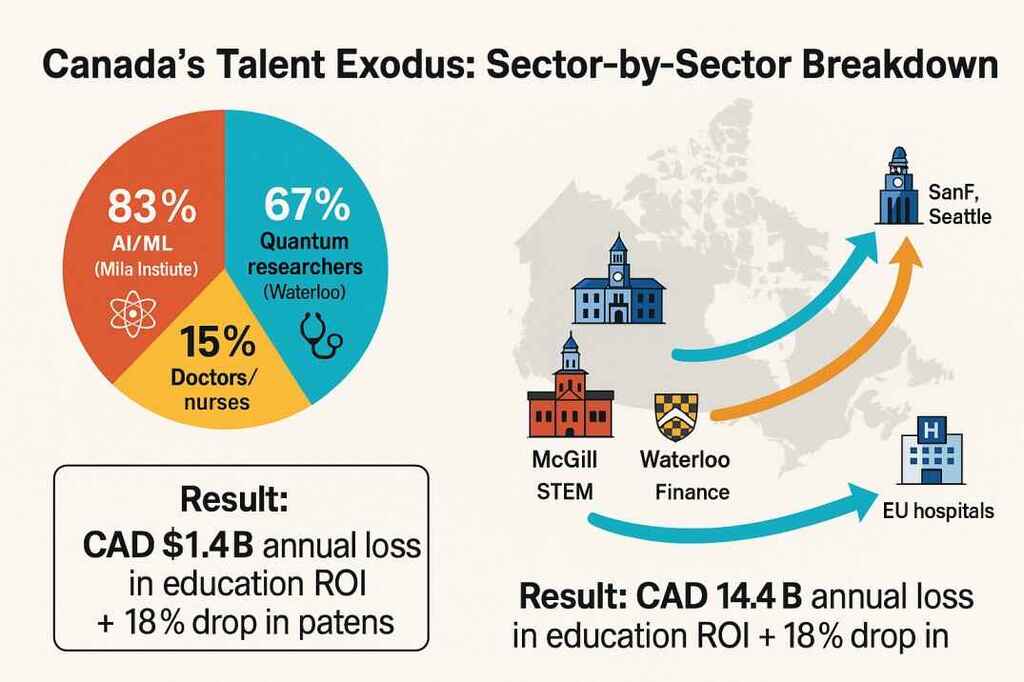
83% of graduates from Montreal’s Mila Institute in AI/ML accept jobs abroad.
67% of researchers from Waterloo’s Institute for Quantum Computing are recruited by U.S. firms.
These disparities have real economic consequences. Since 2020, Canada has seen a 22% decline in AI patent filings, a key metric of Canadian innovation output.
Canada’s Talent Exodus: Sector-by-Sector Breakdown "A visual dive into where Canada's brightest go and why it’s costing the nation billions
Global Talent Retention: How Canada Compares
Canada’s brain drain challenge is stark when viewed in international context:
Germany retains 85% of its STEM graduates through robust university-industry ties.
TheU.K.loses 10% of its nurses annually but counters with aggressive visa incentives.
China, once a net exporter of talent, now reverses its trend with targeted R&D programs and the Thousand Talents initiative.
Africa loses 20% of its educated workforce, though largely due to instability, not policy failure.
Canada’s unique problem lies in the disproportionate loss of high-value talent, especially in AI, quantum computing, and biotech, which are essential to future economic competitiveness.
Beyond Tech: Other Sectors Hit by Talent Flight
The Canadian brain drain extends beyond STEM:
Healthcare: Canada loses 15% of trained doctors and nurses to the U.S. and Europe, worsening wait times and hospital understaffing.
Finance: Analysts and executives migrate to hubs like New York and London, where salaries outpace Toronto by nearly 50%.
Agriculture & Agritech: Innovators in sustainable farming are drawn to well-funded R&D centers abroad, impeding domestic advancements in food security and agricultural innovation.
These losses across sectors reveal a system-wide erosionof Canada’s human capital base.
Root Causes: Where STEM Policy Canada Falls Short
Key market and policy gaps continue to drive this tech talent migration:
Tax Disincentives
Marginal tax rates exceed 50% for high earners, compared to more competitive U.S. systems.
U.S. offers 401(k)s, better capital gains structures, and R&D tax credits that improve long-term earning potential.
Venture Capital Deficit
Canada sees only CAD $146 in venture capital investment per capita vs. CAD $483 in the U.S.
Nearly 90% of Canadian startups seeking Series B+ funding relocate to the U.S. to access capital.
Canada's Corporate R&D Shortfall
Canadian businesses invest just 1.6% of GDP into R&D, compared to 3.1% in the U.S.
This weakens the entire Canadian innovation ecosystem, making it hard to scale frontier technologies domestically.
The Innovation Drain Effect: Measuring Economic Impact
Direct Losses: Canada forfeits CAD $1.4 billion annually due to public education investments in students who then emigrate.
Indirect Impacts:
Domestic patent filings have declined by 18% since 2015.
McGill’s Computer Science program fell 11 global ranking places.
Canada’s innovation economy risks stagnation as talent and ideas fuel foreign competitors instead.
Policy Solutions: Building a National Talent Retention Strategy
Solving the brain drain crisis requires coordinated action and bold reforms:
Short-Term (0–2 Years)
Talent Bonds: Offer student loan forgiveness for STEM graduates committing to five years of work in Canada.
Anchor Employer Incentives: Provide 25% payroll tax credits for firms that hire top-tier STEM talent.
Healthcare Retention Grants: Subsidize relocation and rural service bonuses for doctors and nurses.
Medium-Term (2–5 Years)
Boost VC Access: Double Canada’s per capita VC to CAD $300 via public-private funds.
Raise Corporate R&D Spending: Target 2.5% of GDP using tax credits and innovation incentives.
Align Education with Jobs: Re-tool academic curricula to reflect actual hiring needs in finance, healthcare, and agritech.
Long-Term (5–10 Years)
Tax Modernization: Lower marginal rates for high earners and align with global norms.
Sectoral Retention Frameworks: Establish targeted retention strategies for AI, quantum computing, and biotech (note: any export controls must be ethical and transparent).
Global Talent Hub: Create immigration fast-tracks to retain international graduates and build a sustainable pipeline of high-skill workers.
Path forward: A Defining Choice for Canada’s Future
Canada’s STEM talent exodus is no longer anecdotal, it’s a structural crisis. The country now faces a defining choice: reform its STEM policy, R&D environment, and talent infrastructure or accept the role of a training ground for the world’s innovation superpowers.
As the Ottawa Science Policy Network puts it, “conducive policy changes are essential to building an environment where Canadian talent chooses to stay.”
Unless bold, coordinated action is taken, Canada risks losing the very minds it invests so heavily to educate, and falling behind in the global innovation race.