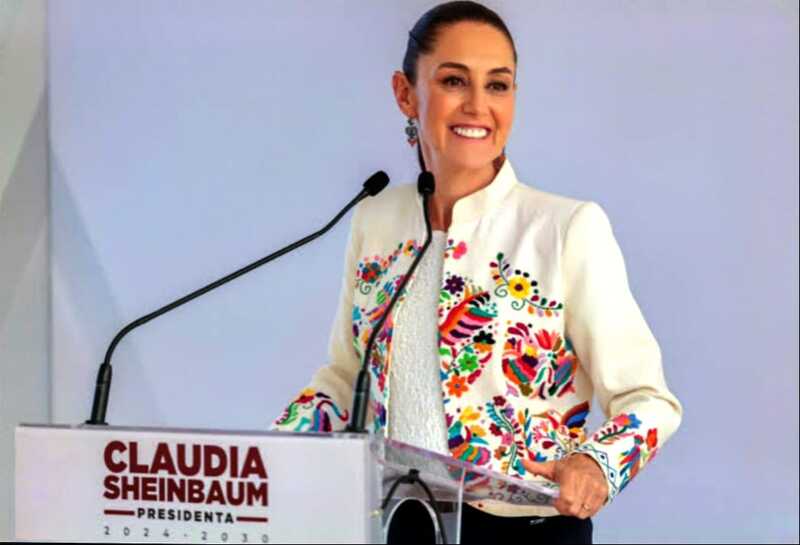
Claudia Sheinbaum explaining why she didn't meet the businessman Gonzalez Laporte. Photo Credits: K via X
NorthAmerica
Claudia Sheinbaum becomes Mexico's first female president. Explore her economic agenda, security strategy against cartel violence and what her leadership means for investors and women in politics.
Mexico has entered a historic new chapter with the election of its first female president, Claudia Sheinbaum, who follows populist former president Andrés Manuel López Obrador.
Her victory marks a symbolic and political milestone for the nation, and the public now watches closely to see how her administration will shape the future of one of Latin America’s most dynamic and rapidly evolving economies. Expectations are high, and many hope Sheinbaum will build on past progress while addressing the country’s most urgent challenges.
Economic Growth and Challenges
During López Obrador’s presidency, Mexico achieved notable poverty reduction and maintained steady economic performance despite controversial and polarizing policies. With GDP growth at 2.4% and the economy valued at $2.017 trillion in nominal terms—and $3.434 trillion in Purchasing Power Parity as of 2024—Mexico has demonstrated resilience in a shifting global landscape.
President Sheinbaum is expected to expand social programs, strengthen industrial development, and accelerate initiatives aimed at boosting productivity and foreign investment. Her administration faces the dual task of sustaining growth while modernizing infrastructure and improving labor conditions to ensure long-term economic stability.
President Sheinbaum is expected to expand social programs, strengthen industrial development, and accelerate initiatives aimed at boosting productivity and foreign investment. Her administration faces the dual task of sustaining growth while modernizing infrastructure and improving labor conditions to ensure long-term economic stability.
Security Issues and Gang Violence
Despite economic progress, Mexico continues to grapple with severe security threats. High rates of murder, armed robbery, sexual assault, kidnapping, and drug-related violence remain persistent concerns.
Organized crime groups exert significant influence across major regions, especially near border entry points where drug trafficking routes are heavily contested. Small businesses are particularly vulnerable, with extortion cases rising more than 60% since 2022. These conditions create an atmosphere of fear that undermines local commerce and discourages new investment.
Organized crime groups exert significant influence across major regions, especially near border entry points where drug trafficking routes are heavily contested. Small businesses are particularly vulnerable, with extortion cases rising more than 60% since 2022. These conditions create an atmosphere of fear that undermines local commerce and discourages new investment.
Impact on Small Businesses and Investment
The ongoing violence poses substantial risks for entrepreneurs and investors alike. As gang control spreads into additional municipalities, the instability threatens to derail Sheinbaum’s economic agenda. Restoring investor confidence will require decisive government action, improved law enforcement coordination, and long-term strategies to weaken criminal networks.
Organized Crime and Political Violence
Political violence has also intensified. Candidates and public officials are frequently targeted by criminal groups seeking influence or retaliation. The recent assassination of the mayor of Chilpancingo—just six days into Sheinbaum’s presidency—underscores the urgency of confronting organized crime with renewed focus and strategic planning.
President Sheinbaum’s Focus on High-Crime Areas
In response, Sheinbaum has prioritized reducing homicide rates in regions most affected by cartel activity, including Colima, Tijuana, Acapulco, and Celaya. These hotspots account for roughly a quarter of all organized crime-related killings nationwide, making them central to her security strategy.
Expectations for Women in Leadership
Sheinbaum has highlighted the importance of women demonstrating strong, capable leadership in high-stakes roles. As she confronts gang violence, her administration will need to balance firmness with caution to avoid escalating conflicts between rival groups. Her success could redefine public perceptions of women in political leadership and set a precedent for future generations.