Europe's youth unemployment crisis: 14% jobless rate, Spain and Greece above 27%, root causes, EU Youth Guarantee & solutions. Explore the road ahead.
Youth unemployment continues to cast a long shadow over Europe’s future. Despite recovering from the Eurozone crisis and recent economic shocks, young people across the EU still face unemployment rates more than double the overall population. This persistent inequality threatens not only individual livelihoods but also Europe’s broader economic resilience and social cohesion.
Youth Unemployment: A Story of Regional Disparities
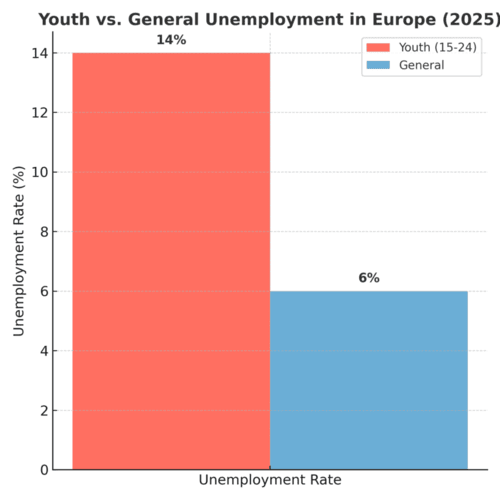
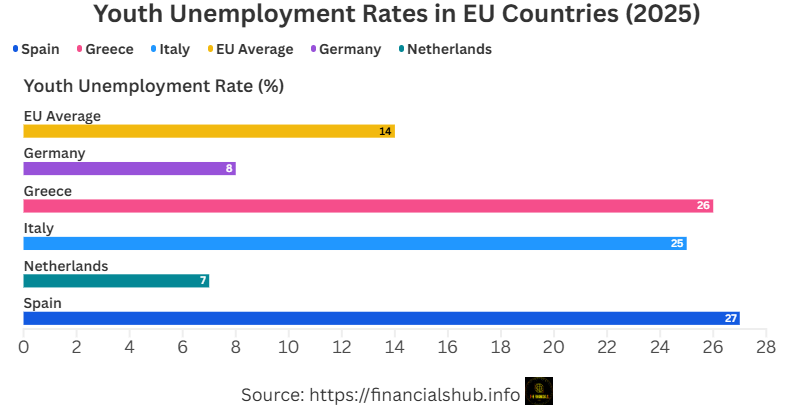
As of early 2025, the European Union has an estimated unemployment rate of around 6%. However, among young people aged 15–24, the rate rises to approximately 14%, according to data from Eurostat (2025). In certain member countries, the situation is even more severe. Spain’s youth unemployment rate exceeds 27%, with Greece and Italy following closely, where more than one in four young people are out of work.
A representation of Youth vs General Unemployment rate in Europe (2025)
These disparities reflect long-standing structural issues: rigid labor markets, sluggish economic growth, and educational systems often misaligned with evolving labor market needs. In many Southern and Eastern European countries, young people face either underemployment, precarious short-term roles, or complete exclusion from job markets.
By contrast, nations like Germany, Austria, and the Netherlands report youth unemployment rates below 10%, largely due to dual vocational training systems, robust industrial sectors, and effective school-to-work transition mechanisms (OECD, 2023).
Visual representation of Youth Unemployment in a number of European countries (2025)
Root Causes Behind Youth Joblessness
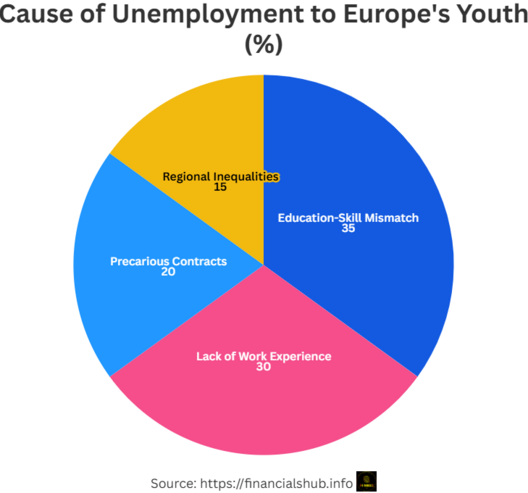
Youth unemployment in Europe is influenced by multiple interconnected challenges, including:
Lack of work experience: Many employers seek candidates with prior experience, leaving first-time job seekers at a disadvantage. This “experience trap” is especially common in competitive urban markets.
Education-labor market mismatch: In some countries, curricula remain theoretical or outdated, failing to equip students with the practical and digital skills demanded by employers (CEDEFOP, 2024).
Precarious employment: Young workers are disproportionately affected by short-term or part-time contracts, often lacking job security, benefits, or career progression.
Regional inequalities: In less-developed rural or post-industrial regions, particularly in the South and East, local economies often fail to generate meaningful opportunities for youth.
Visual representation of Youth Unemployment in a number of European countries (2025)
Opportunities Emerging from Crisis
Despite these persistent obstacles, there are reasons for optimism. Europe’s transition to a digital and green economy is driving demand for new skills and jobs in sectors such as clean energy, information technology, and sustainable infrastructure. These areas are increasingly attractive to environmentally and socially conscious younger generations.
Initiatives like the EU Youth Guarantee, which promises access to employment, continued education, or training within four months of becoming unemployed or leaving formal education, have made a tangible impact in several countries. For instance, Finland and Austria have reported successful outcomes due to strong coordination between public employment services, training institutions, and private sector stakeholders (European Commission, 2024).
Moreover, a rising entrepreneurial spirit among European youth is reshaping traditional job-seeking patterns. Start-up ecosystems in cities like Berlin, Lisbon, and Tallinn are fostering innovation through co-working spaces, mentorship networks, and funding opportunities, creating viable alternatives to conventional employment.
The Road Ahead: EU Policy and Practice
Addressing youth unemployment demands coordinated, forward-thinking action across multiple fronts:
Modernizing education: School and university curricula must evolve to match the demands of rapidly transforming sectors, especially in digital, green, and healthcare industries. Continual learning and skill development are crucial for staying relevant and adapting to changing demands.
Promoting mobility: Programs such as Erasmus+ and cross-border apprenticeship schemes should be expanded to help youth access opportunities beyond their local or national markets.
Investing in underdeveloped regions: Targeted economic development, infrastructure upgrades, and local entrepreneurship programs are critical in bridging the urban-rural and North-South divide.
Building supportive work environments: Employers should prioritize job stability, fair compensation, mental health, and continuous skill development to retain and empower young workers.
The Next Decade Will Define a Generation
Europe stands at a critical juncture. Youth unemployment remains a formidable challenge, but the tools to address it, education reform, targeted investment, and inclusive innovation, are within reach. The next decade will determine whether the continent can harness its young population’s potential or allow inequalities to deepen.
Will Europe seize this opportunity to unlock the full promise of its youth? The answer will shape not only the continent’s future, but the fate of an entire generation.