What happens if Iran closes the Strait of Hormuz? Explore the oil-price shock, supply-chain fallout, hardest-hit economies, and four possible futures for global markets.
In a move that has sent global markets into a frenzy, Iran has threatened to choke off the Strait of Hormuz, the narrow lifeline through which nearly a fifth of the world’s oil flows. As geopolitical tensions in the Middle East reach a boiling point, the specter of skyrocketing oil prices, disrupted supply chains, and economic turmoil looms large.
With the global economy already on shaky ground, this high-stakes gambit could ignite an energy crisis that reverberates from Wall Street to gas pumps worldwide.
The Strait of Hormuz: World's Most Critical Oil Chokepoint
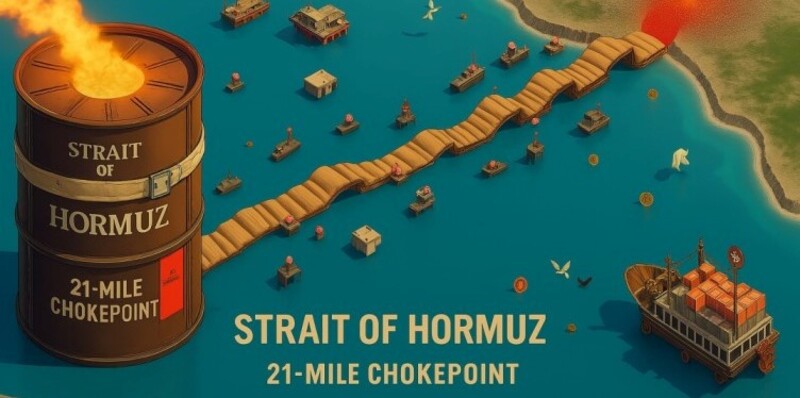
The 21-mile-wide Strait of Hormuz, linking the Persian Gulf with the Arabian Sea, is a vital artery for the world's energy supply. This critical chokepoint handles roughly 20 million barrels of oil daily, powering economies worldwide. Iran, controlling its northern coast, leverages this strategic advantage.
Its recent threat to close the strait, authorized by parliament on June 22, 2025, following Israeli airstrikes on Iranian nuclear sites and U.S. involvement, marks a dangerous escalation. This revives fears of a blockade, potentially strangling global oil flows and destabilizing an already fragile world economy.
Why Iran's Threat Is More Than Just Bluster
Iran has repeatedly used the threat of closing the Strait of Hormuz as a geopolitical lever, notably during the 1980s Iran-Iraq War when it mined the strait, disrupting but not halting shipping. In 2012, Vice President Mohammad-Reza Rahimi vowed to block the strait if sanctions curbed Iran's oil exports, sparking a 4% spike in crude prices. The most recent threat to impose a blockade is a strategic reaction to U.S. strikes on its nuclear facilities.
Tehran's Supreme National Security Council is reportedly considering the move to pressure the West, risking naval confrontations with U.S. and U.K. forces in the Gulf. China and Russia have called for restraint, while Saudi Arabia, a major oil exporter, prepares for possible disruptions. Analyst Farzin Nadimi warns this escalation could unite Iran's rivals and spark a wider regional conflict.
Tehran's Gambit: Sovereignty vs. Economic Suicide
Iranian state media and political analysts portray the Strait of Hormuz not just as a pressure point but as a symbol of national sovereignty. From Tehran's view, the West's continued economic sanctions, coupled with covert attacks and drone strikes on critical infrastructure, warrant a forceful response.
According to Iran's Foreign Ministry spokesperson Nasser Kanaani, "The West cannot strangle our economy and expect us to keep vital shipping open unconditionally." Hardliners within Iran's parliament argue that closing the Strait is a legal and justified defensive move, not a provocation.
Oil Markets in Panic: Prices Swing Like a Pendulum
The threat to shut the Strait of Hormuz has sent global oil markets into turmoil. According to The Guardian, Brent crude prices surged to a five-month high of $81.40 per barrel on June 23, 2025, following U.S. airstrikes on Iranian nuclear sites. However, as fears of an immediate blockade eased, prices plummeted over 15% to $66.76 by June 26, CNBC reported. The New York Times highlighted that stock exchanges worldwide, from London's FTSE 100 to New York's S&P 500, wavered amid uncertainty over potential disruptions to nearly 20% of global oil flows.
Asia's Energy Nightmare: Who Gets Hit Hardest?
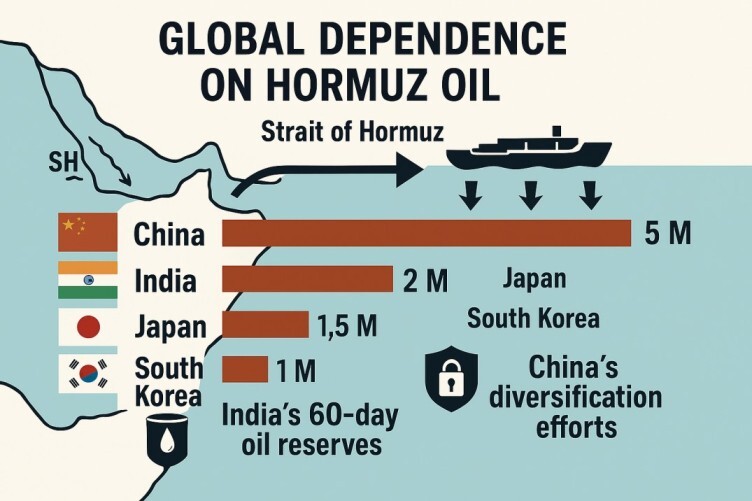
Asian economies, especially China, India, South Korea, and Japan, would be significantly impacted. The U.S. Energy Information Administration estimates that China imports approximately 5 million barrels per day through the strait, while India and South Korea rely on 2 million and 1 million barrels respectively. India's Petroleum Minister Hardeep Singh Puri reassured that the country has diversified its oil sources and maintains reserves to mitigate shocks, but experts warn inflation and trade deficits could worsen if the crisis escalates.
Global dependency on the Strait of Hormuz
The strait facilitates oil shipments from Saudi Arabia, the UAE, Kuwait, and Qatar. Disruption would not only affect oil but also liquefied natural gas shipments, particularly from Qatar, which accounts for about one-fifth of global LNG supply.
Experts warn that a full closure of the strait could push oil prices beyond $100 per barrel, severely impacting global trade. Sugandha Sachdeva, founder of SS WealthStreet, described the situation as "a powder keg for global trade," emphasizing the catastrophic risks to energy-dependent economies.
Iran's Secret Economic Armor: Can It Survive a Blockade?
Despite the potential for economic self-harm, Iranian officials believe they can withstand the shock. They cite expanded oil trade with China, barter agreements with Russia, and domestic fuel subsidies as buffers against Western retaliation. "We are prepared for economic resistance," said Ebrahim Raisi, President of Iran. "The Strait is our leverage, and we will use it to ensure our national security is not compromised."
Three Ways the World Could Counter Iran's Move
Diplomacy: Pursuing discreet diplomacy through neutral mediators like Oman, offering Iran economic incentives to keep the Strait of Hormuz open.
Military: A global naval coalition could deploy anti-mine and anti-drone systems to secure the strait, ensuring safe passage for 20 million barrels of daily oil while deterring Iran's blockade threats.
Energy Diversification: Countries could ramp up renewable energy investments to reduce oil dependence and redirect shipments through alternative routes like Saudi Arabia's East-West Pipeline or Iraq's Kirkuk-Ceyhan line, bypassing the strait. These pipelines, though limited in capacity, could ease supply shocks, stabilizing global markets against Iran's gambit.
Voices of Dissent: Inside Iran's Divided Leadership
Not all voices in Iran back the closure. Reformists and moderates in the Majlis (Parliament) argue that shutting the strait would isolate Iran further, drive away neutral trading partners, and embolden anti-Iran coalitions. Former Foreign Minister Javad Zarif tweeted, "Closing Hormuz is not a strategy, it's a trap. Diplomacy must remain Iran's front line."
Will Diplomacy or War Decide the Strait's Fate?
With Iran's threat to close the Strait of Hormuz still hanging over global markets, the world teeters on the edge of an energy catastrophe. Oil prices, trade routes, and economies remain hostage to Tehran's next move, while diplomatic efforts falter under the weight of mistrust. If the strait shuts, the fallout could cripple global commerce and ignite a recession. As nations scramble to secure energy supplies and investors brace for volatility, the coming days will decide whether this crisis spirals into chaos or cools through fragile talks. The global economy awaits its fate.
Four Possible Futures, From Chaos to Cold Peace
Short-Term Shock, Long-Term Diversification: Even a brief closure could jolt markets enough to accelerate diversification away from oil dependence, reinforcing renewable energy agendas in Europe and Asia.
Iranian Leverage or Isolation: If Iran backs down after showcasing power, it may earn temporary diplomatic leverage. However, if it follows through, global retaliation could isolate Iran economically and militarily.
Risk of Escalation: Missteps by U.S. or Israeli naval forces, or an errant missile in the Gulf, could spiral into a regional war involving Saudi Arabia, the UAE, and potentially NATO.
Shift in Alliances: The crisis may redraw geopolitical alliances, with China and Russia possibly backing Iran more openly, while Gulf nations seek closer military guarantees from the West.