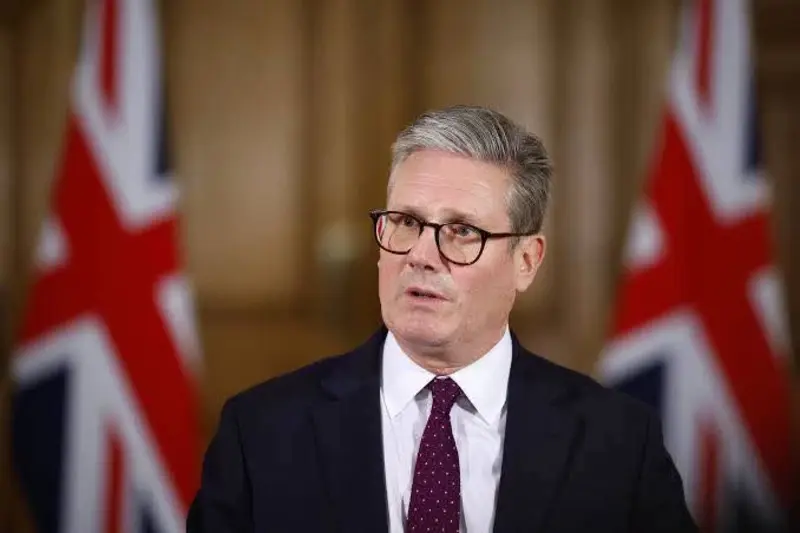
Keir Starmer speaking in front of UK flags during an official address to the British Labour Party members
Europe
Keir Starmer resigned as UK Prime Minister on June 22, 2026, after a chain of political crises that included local election losses, public unpopularity, ministerial resignations, and a vetting scandal—though he remains caretaker until September 1. Greater Manchester Mayor Andy Burnham has emerged as the likely successor, poised to shift Labour sharply leftward on public ownership and devolution.
Key Takeaways
Starmer's fall was driven by four compounding failures: record local seat losses of about 350 with hits in the Party's strongholds, 42% public disapproval, the Mandelson-Epstein vetting scandal, and mass resignations including Defence Secretary John Healey.
Burnham is the clear frontrunner after winning the Makerfield by-election and securing Wes Streeting's endorsement, and he will pivot away from centrism toward public ownership of transport, housing, and utilities, plus major regional devolution.
Political uncertainty persists: the new leader may either govern until 2029 or call an early snap election, continuing Britain's pattern of six PMs since 2010.
Starmer’s Resignation, A Sixth PM in 16 Years - The Uncertain Road Ahead
As of June 22, 2026, Keir Starmer has resigned as the UK’s Prime Minister and leader of the Labour Party. This contrasts with his earlier comments that he would fight for the leadership and was not ready to resign.
A new leader is expected to take over by the time parliament resumes in September 2026. Since 2010, Britain has had six Prime Ministers: David Cameron, Theresa May, Boris Johnson, Liz Truss, Rishi Sunak, and Keir Starmer (Labour Party).
UK Prime Ministers 2010–2026 chart showing David Cameron, Theresa May, Boris Johnson, Liz Truss, Rishi Sunak, and Keir Starmer with party affiliations and term dates.
The Labour Party took over leadership through Starmer after a 14-year wait, since Gordon Brown served as the last Labour Prime Minister from 2007 until his resignation following the 2010 general election.
Though Starmer has resigned, he is currently remaining in post as a caretaker prime minister to ensure an orderly handover. The formal Labour leadership contest is scheduled to start on July 9, 2026, with a new prime minister expected to take office by September 1, 2026.
The Labour Party has raised the question: "Is Starmer in the best position to lead the party in the upcoming general elections?" His resignation has created uncertainty, as Labour’s new leader may decide whether to continue governing until 2029 or call an early election. Historical precedent exists for early UK elections—Theresa May (2017) and Boris Johnson (2019) both called snap elections to strengthen their mandates.
Why Starmer Resigned as UK Prime Minister
Several factors have been attributed to Starmer’s resignation as UK Prime Minister, ranging from electoral defeats to internal party rebellions.
1.Disastrous Local Election Losses (May 2026)
This was a key factor that led to distrust among the Labour Party members regarding Starmer’s leadership. The party lost nearly 350 local council seats with strong losses in strongholds such as Scotland , Wales and North England taking centre stage in the losses. The losses showed that the Labour Party was vulnerable even in its safest areas.
2. Public Unpopularity and Policy Backlash
Since the historic victory in 2024 when the Labour Party took over leadership, Starmer’s administration has suffered from widespread public disapproval. The public has been frustrated with sluggish economic growth, high borrowing costs, and rising inflation.
Starmer was criticized for his ever-changing policies and a failure to address the cost-of-living and energy crises in the U.K. Additionally, a survey by Pollcheck published before his exit revealed that about 42% of the British population believed that he should step down as Prime Minister.
3.The Peter Mandelson Vetting Scandal
Starmer was heavily criticised for the appointment of Peter Mandelson as the UK’s Ambassador to the United States. Leaked emails showed that Mandelson had a friendly relationship with Jeffrey Epstein, who pleaded guilty in Florida to sex offences against minors. As a result, MPs heavily criticized Starmer for poor judgement and a lack of transparency, triggering high-level resignations in Downing Street.
4. Ministerial Resignations and Defence Disputes
Weeks prior to his resignation, Starmer faced high-level resignations within his leadership. John Healey (Defence Secretary) resigned on June 12, 2026, criticizing Starmer’s defence spending plans. Healey argued that Starmer’s proposed increase to 2.68% of GDP by 2030 was inadequate compared to Germany’s planned 3.7%.
This came at a time of heightened global tensions. Starmer’s woes were deepened by the resignations of other ministers, such as Miatta Fahnbulleh, Alex Davies-Jones, and Zubir Ahmed, who joined over 80 MPs demanding Starmer’s resignation.
The Return of Andy Burnham
The final blow came on June 18, 2026, when the popular Greater Manchester Mayor, Andy Burnham, won a decisive parliamentary by-election in Makerfield. This proved to be a turning point that resulted in massive support for Burnham among Labour Party members.
Burnham has been rallied to take over after Starmer, particularly after former Health Secretary Wes Streeting (who previously resigned from Starmer's cabinet in protest) publicly announced that he will not run. Instead, Streeting has thrown his full support behind Burnham, citing Burnham's desire to build an "inclusive party."
What a Burnham Government Might Look Like
In a scenario where Andy Burnham takes over as the next British Prime Minister, he is likely to move away from Starmer's centrist policies. Instead, he is likely to lean towards the left wing of the Labour Party's traditional values by advocating for bringing transport, housing, and utility companies back under public control.
Burnham has a long-standing grievance with Westminster-centric politics and plans to decentralise political power by granting much heavier authority to the UK's regional governments.
Uncertainty Ahead for UK Politics
Bottom Line: Starmer resigned because voters lost trust and his own party turned against him. Burnham is the most likely candidate to take over with more left-wing policies. However, this presents uncertainty in UK affairs at a time of global tensions, energy crisis, and rising inflation—all of which will be a headache for the next British Prime Minister.
FAQs
1. When will the new Prime Minister officially take over? The formal Labour leadership contest starts July 9, 2026, with the new PM expected to take office by September 1, 2026.
2. Why did Starmer resign despite earlier saying he would fight on? He was forced out by disastrous May 2026 local elections, sinking poll numbers, the Peter Mandelson vetting scandal (Epstein ties), and over 80 MPs demanding his resignation.
3. Will there be an early general election? Possibly. The new Labour leader could choose to govern until the scheduled 2029 election or call a snap vote to secure a mandate, following precedents set by Theresa May (2017) and Boris Johnson (2019).
4. Who is Andy Burnham and why is he the favourite? He is the popular Greater Manchester Mayor who won a decisive by-election in Makerfield on June 18. Former Health Secretary Wes Streeting publicly endorsed him over running himself, consolidating party support.
5. How would a Burnham government differ from Starmer's? Burnham would move left advocating to renationalize transport, housing, and utilities, while decentralizing power from Westminster to regional governments, reversing Starmer's centrist approach.