How immigration crackdowns are squeezing U.S. industries: labor shortages, rising costs, GDP risks and sector-by-sector fallout. Inside the economic cost.
Across North America, headlines are being dominated by protests and intense political debates surrounding immigration enforcement. Yet beneath the public demonstrations lies a quieter story: Businesses are facing labor shortages and rising costs as immigration policies reshape the workforce. In a country built on immigrant labor, the political battle over borders is now a battle for survival for key industries and the livelihoods of millions.
Trump-Era Policies Reshape U.S. Immigration Enforcement
Immigration enforcement has undergone a dramatic shift under the Trump administration. Since January 2025, executive orders have tightened border security, expanded deportation efforts, and raised the annual deportation target to one million, tripling previous levels.
From Streets to Courtrooms: Legal Pushback in Sanctuary Cities
New regulations now require undocumented immigrants to register with federal authorities, increasing detention risks. The administration expanded local law enforcement’s role via 287(g) agreements (ICE, 2024) and threatened funding cuts to sanctuary cities. In Los Angeles, protests erupted in response.
Thousands of National Guard troops and Marines were deployed to manage the unrest (Los Angeles Times, 2025). Local officials challenged the use of military forces in federal court.
The Economic Fallout of Immigration Restrictions
Immigrants and GDP: The Growth Engine at Risk
Immigration has historically fueled U.S. economic growth. According to the Congressional Budget Office (CBO), immigration could increase U.S. GDP by $8.9 trillion from 2024 to 2034 (CBO, 2024).
How Deportations Could Shrink the U.S. Economy by 7%
TheParis School of Economics estimates that immigration restrictions could reduce U.S. GDP by 2–7% by 2028 — more than five times the economic cost of trade protectionism (PSE, 2023).
CBO vs. Peterson Institute for International Economics: Conflicting Economic Projections.
While the CBO sees growth, the Peterson Institute for International Economics (PIIE)warns that deporting 1.3 to 8.3 million undocumented immigrants could reduce real GDP by up to 7% by 2028 (PIIE, 2023).
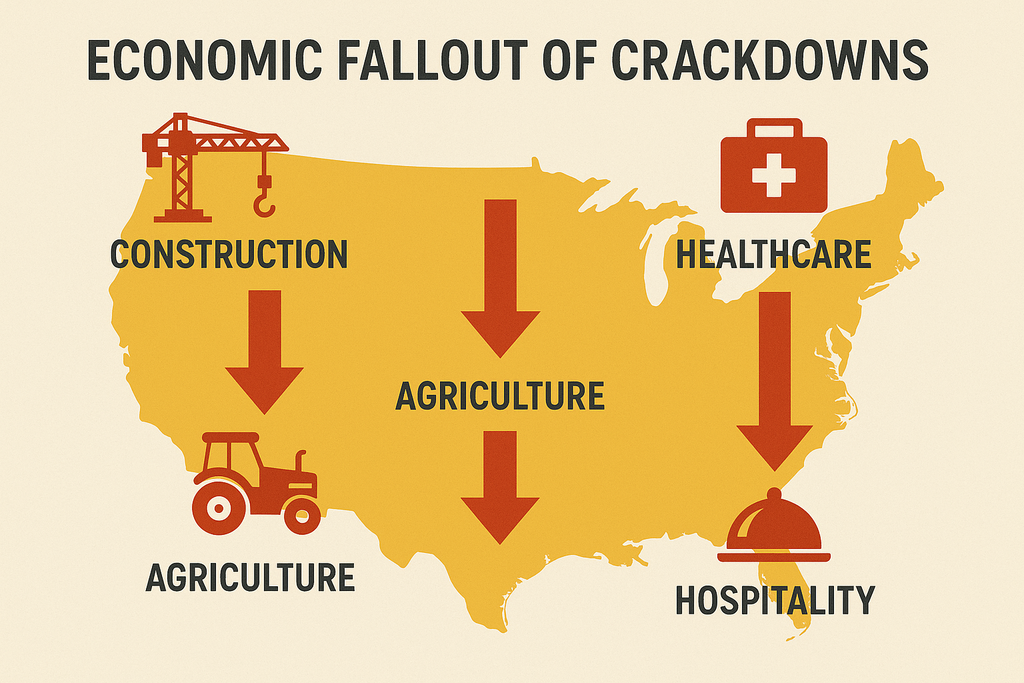
A chart showing the economic fallout of crackdowns in the US 2025
Industry by Industry: Labor Shortages Unfold
Construction Delays and Housing Costs Surge
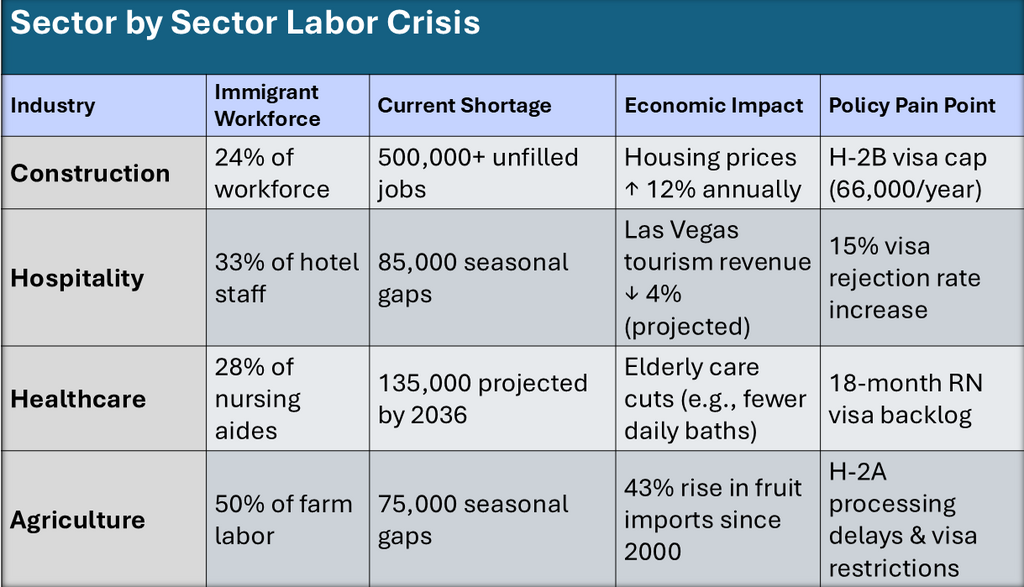
The construction industry faces acute labor shortages. Las Vegas, which relies on ~190,000 undocumented workers , nearly 9% of its workforce, has been hit particularly hard.
Hospitality Industry Struggles to Stay Staffed
Hotels struggle to fill seasonal roles. The H-2B visa program, capped at 66,000, is overwhelmed. Although DHS added 85,432 visas in 2024, stricter vetting increased rejection rates by around 15% (Department of Homeland Security, 2024).
Chris Nassetta, CEO of Hilton, stated that labor gaps pose a long-term risk to the industry’s sustainability.
Healthcare Sector Faces a Worker Crisis
The Bureau of Labor Statistics (BLS) projects a shortage of 135,000 providers by 2036 (BLS Occupational Outlook Handbook). In Los Angeles, immigrants make up 15.6% of nurses and 27.7% of aides (New American Economy, 2023).
Food Inflation Driven by Agricultural Labor Gaps
Immigrants comprise over 50% of California’s agricultural workers. Labor shortages led to a 42.7% increase in fruit imports and a 31.9% increase in vegetables between 2000 – 2019 (U.S. Department of Agriculture, 2022).
Transportation and Manufacturing Strain Supply Chains
Urban areas face trucking shortages. Meanwhile, The Manufacturing Institute projects a shortfall of 2.1 million jobs by 2030, potentially costing $1 trillion (National Association of Manufacturers, 2023).
A table showing sector by sector labor crisis as of 2025
U.S. vs. Canada: A Tale of Two Immigration Strategies
The U.S. and Canada take divergent approaches to immigration labor policies, with significant economic implications.
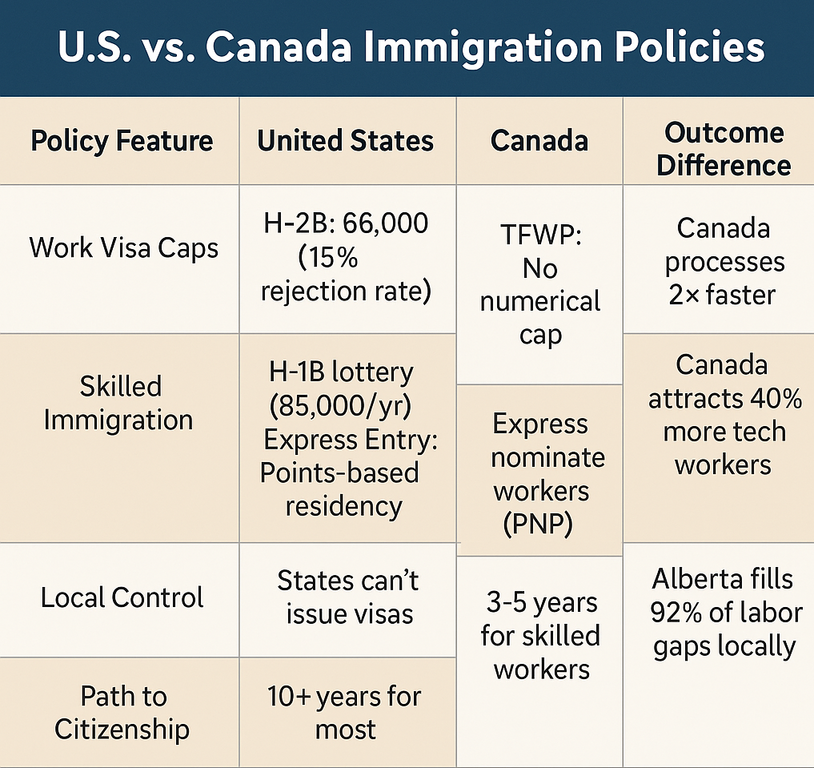
The U.S. relies on temporary visa programs like H-2A and H-2B, which are capped and subject to rigorous vetting. The H-2B program, limited to 66,000 visas annually, saw rejection rates increase by 15% since 2022.
In contrast, Canada’s Temporary Foreign Worker Program (TFWP) offers greater flexibility, allowing employers to hire foreign workers for low- and high-skilled roles with fewer restrictions. Canada’s Express Entry system prioritizes skilled immigrants for permanent residency, ensuring a steady labor supply.
Canada’s Provincial Nominee Program (PNP) allows provinces to address local labor needs by nominating immigrants for permanent residency, unlike the U.S.’s centralized system, where state-level input is minimal.
For example, the stalled U.S. Seasonal Act, which would allow governors to petition for additional H-2B visas, highlights this gap. Canada’s policies have bolstered its agricultural sector, contributing to its dominance in U.S. fresh produce imports. By contrast, the U.S.’s restrictive approach drives up costs and reduces competitiveness.
A table comparing U.S. to Canada's Immigration services
Policy Paths Going Forward: Fixing the U.S. Workforce Gap
Short-Term Fixes: Raise Visa Caps and Streamline Work Permits
Increasing the H-2B visa cap beyond 66,000 and streamlining applications would alleviate shortages in construction, hospitality, and agriculture.
Fast-tracking work permits for asylum seekers, who face delays of six months or more, would allow them to fill critical roles.
Updating the Department of Labor's Schedule A list to include high-demand occupations, such as builders and healthcare workers, would expedite hiring.
Long-Term Reforms: Legal Pathways for Essential Workers
Creating a path to citizenship for essential workers, especially undocumented immigrants in agriculture, construction, and healthcare, would stabilize the workforce and boost tax revenues, potentially adding $1.2 trillion over a decade, per CBO 2024 estimates.
State-Based Visa Programs: Empowering Local Solutions
Adopting state-based visa programs, inspired by Canada’s PNP, could help states directly address regional labor shortages.
What Businesses Can (and Can’t) Do
Automation as a Partial Answer , But Not for All Sectors. While robotic harvesting is advancing in agriculture (MIT Technology Review, 2023), automation in hospitality or healthcare remains costly and limited.
Wage Increases Could Attract Workers — and Raise Inflation. Raising wages could attract more domestic workers but risks inflation, which surged during 2021–2023 following post-pandemic labor pressures (Federal Reserve, 2023).
Upskilling Domestic Workers Requires Time and Investment. Partnerships with colleges and trade schools can help, but require long-term planning and capital outlays (Brookings Institution, 2023).
Beyond the Border: The Real Cost of Crackdowns
1. How Immigration Policy Impacts the Broader Economy From GDP shrinkage to industry disruption, immigration policy affects the entire economy, not just border states or migrants.
2. Consumers, Workers, and Businesses All Pay the Price Everyday Americans are seeing higher food prices, longer construction timelines, and limited healthcare access.
3. Balancing National Security with Economic Stability Smart policies must protect both borders and economic resilience. Without reform, the hidden cost of immigration crackdowns may reach far beyond politics.