Transparent globe with coin stacks and green trees, symbolizing Africa’s climate finance gap, less than 4% of $1.9T global flows reach the continent. Image credits: Nelly Ndaire via Kencrave
Africa gets just 4% of global climate finance despite producing under 4% of emissions. Explore the structural barriers, greenwashing risks, debt-for-climate swaps, and 2030 roadmap to close the $1 trillion gap.
Executive Summary
Africa produces under 4% of global greenhouse gas emissions yet faces the world’s harshest climate impacts, losing 2-5% of GDP each year and spending up to 9% of national budgets on disaster response. Although global climate finance reached $1.9 trillion in 2023, Africa receives only 4% of it: about $28 billion, far below the $250–300 billion needed annually for resilience.
Three structural failures drive this inequity. First, more than 90% of climate finance comes as loans rather than grants, pushing countries to borrow at high rates for crises they did not create, while projected 2025 debt service ($88.7 billion) already surpasses total climate finance inflows.
Second, less than 20% of adaptation funding reaches local communities due to bottlenecks in multilateral systems, limited institutional capacity, and elite capture. Third, women who make up 70% of Africa’s agricultural workforce, receive under 10% of climate finance and support services, undermining a key source of resilience. Related analysis: Gender Disparity in Funding is such a critical issue not only in Africa but also globally.
Solving this requires three urgent shifts by 2030: (1) a significant move toward grants and concessional finance, (2) guaranteed direct funding for community-based and women-led organizations, and (3) enforceable governance reforms to curb corruption and greenwashing.
This analysis examines the origins, current state, and future of climate finance and green investments from a uniquely African perspective with key recommended actions that stakeholders must take.
It explores how green bonds are transforming global capital markets, why Africa receives only a tiny fraction of global climate funds, and why greenwashing threatens to undermine the entire enterprise. The continent faces a structural financing gap that demands immediate and systemic solutions.
Comparative bar chart showing regional climate vulnerability versus climate finance received
What is Climate Finance? Definition, Origins, and Why Africa Needs It
Climate finance refers to all financial resources from public, private, domestic, and international sectors which are mobilized to reduce emissions and support adaptation to climate impacts. It includes grants, loans, guarantees, equity investments, and blended finance. While developed countries are expected to support developing nations under global agreements, climate finance also flows within and among developing countries.
Origins of Climate Finance: From UNFCCC to Paris Agreement
Climate finance emerged from a fundamental recognition that developed countries bear historical responsibility for climate change and thus have an obligation to support developing nations in addressing its impacts.
The concept was formally established through the United Nations Framework Convention on Climate Change (UNFCCC) in 1992, which stated that developed countries should provide financial resources to assist developing nations with climate action. The Kyoto Protocol (1997) and subsequent Paris Agreement (2015) strengthened this commitment, setting ambitious climate finance mobilization goals.
Since the 2009 Copenhagen Accord, where developed countries pledged to mobilize $100 billion annually by 2020, climate finance has grown into a trillion-dollar market. The Accord was drafted by a coalition including the United States and the BASIC countries that is: Brazil, South Africa, India, and China, and was later supported by a broader group of 28 key nations representing over 80% of global emissions.
Countries including Australia, Japan, the EU member states, Russia, Mexico, South Korea, Norway, and others were central to the agreement.
Under the Accord, developed nations committed to $30 billion in "fast-start" financing for 2010-2012 to help developing countries, with specific pledges from Japan ($11 billion), the EU ($10.7 billion), the United States ($3.7 billion), and Norway ($1.5 billion). Beyond that, the goal of $100 billion annually by 2020 was established to support climate action in developing nations.
Global climate finance flows reached approximately $1.9 trillion in 2023, driven largely by investments in renewable energy, electric mobility, and low-carbon infrastructure. The OECD estimates that global low-carbon energy investments now account for 7% of gross fixed capital formation, increasingly exceeding fossil fuel investments.
The evolution of green financial instruments represents one of the most significant developments in modern capital markets. Green bonds, fixed-income instruments whose proceeds are exclusively applied to climate and environmental projects, have grown from a niche product to a mainstream asset class.
The World Bank issued the first green bond in 2008, and the market has since expanded to include sustainability bonds, transition bonds, and nature bonds.
Understanding Green Finance Mechanisms: From Bonds to Carbon Credits
a) Green bonds are debt securities where the money raised is exclusively used for projects with environmental benefits, such as renewable energy, energy efficiency, sustainable waste management, and pollution prevention. The ICMA Green Bond Principles provide guidelines for transparency, disclosure, and reporting, requiring issuers to clearly explain how the money will be used and demonstrate environmental impact.
b) Sustainability bonds broaden the scope by financing both green and social projects, such as affordable housing, healthcare infrastructure, or job creation alongside environmental initiatives. Transition bonds support high-carbon sectors like fossil fuels or heavy industry in transitioning toward low-carbon operations, providing financing for decarbonization efforts.
c) Nature bonds specifically target biodiversity protection and nature-based solutions. Ecobank's $450 million Nature Bond, the first from a commercial bank globally, demonstrates how these instruments can channel capital toward sustainable agriculture, water infrastructure, and conservation in biodiversity-priority countries. The bond carries ICMA's Nature Bond secondary designation and Moody's highest possible SQS1 sustainability quality score.
d) Blended finance combines public and private money to reduce risk for private investors in developing markets. Initiatives like the UNDP's PISTA provide technical assistance and project preparation support, helping bridge the gap between climate priorities and projects that are ready for investment.
e) Carbon credits allow greenhouse gas producers to offset emissions by investing in projects that reduce or prevent carbon dioxide production. Under the Paris Agreement's Article 6, carbon trading has become a multi-billion-dollar market, though it remains controversial due to concerns about integrity, transparency, and greenwashing.
Chart illustrating the forecasted 2026 global issuance across key sustainable bond categories based on projections from S&P Global Ratings and Moody's Ratings.
Key Market Insights
Total Market Projection: The total issuance is expected to fall between $800 billion and $900 billion.
Dominant Category:Green bonds continue to lead the market, accounting for $530 billion (60%) of the projected total.
Secondary Categories: Sustainability bonds ($190 billion) and social bonds ($115 billion) constitute the bulk of the remaining.
Regional Context: It is important to note that Africa currently accounts for less than 0.3% of global ESG bond issuance, highlighting a significant opportunity for growth and development in the region's sustainable finance sector.
Why Africa Receives Less Than 4% of Global Climate Finance: Structural Barriers Explained
Africa presents the starkest illustration of climate finance inequality. Despite possessing abundant renewable energy potential, with the continent receiving enough solar energy to power the entire world several times over, Africa accounts for less than 2% of global energy transition investment. The continent receives only about 3% of global climate finance annually, yet faces some of the most severe climate impacts.
The African Development Bank estimates that Africa requires between $1.3 trillion and $1.6 trillion in climate finance between 2020 and 2030 to effectively address climate change and achieve sustainable development goals. Current finance flows meet only a fraction of these needs.
The financing gap represents not just a funding shortfall but a fundamental structural imbalance. Africa loses about $88.6 billion annually through illicit financial flows, which exceeds the development assistance the continent receives each year.
Africa's rising debt burden has significantly hampered its ability to finance climate action. More than 25 African countries are in debt distress or at high risk, forcing governments to spend more on debt servicing than on critical investments in health, education, and climate resilience.
Sub-Saharan Africa's debt-to-GDP ratio now averages 58%, severely limiting fiscal flexibility. This creates a vicious cycle where countries borrow to survive climate disasters they did not create, undermining their fiscal stability and development prospects.
The share of concessional loans in climate finance portfolios has fallen sharply, with the European Investment Bank's share dropping from 19% in 2017 to just 2% in 2021, indicating increasingly unfavorable lending terms for low-income African countries.
Beyond debt pressures, weak institutional coordination across government ministries leads to fragmented approaches and duplicated efforts. Complex international procedures for accessing climate funds, requiring extensive documentation, technical expertise, and long application timelines, further hamper the flow of resources. The Green Climate Fund's approval rate for African proposals was only 39% up to 2017, reflecting these bureaucratic hurdles.
Insufficient technical capacity at the local level is another critical bottleneck, as many district-level officials and community leaders lack the expertise to design, implement, and monitor climate projects that meet international standards. This capacity gap particularly affects vulnerable groups, including rural farmers, pastoralists, and coastal communities who are most exposed to climate impacts but least equipped to access available financing.
Several African countries are leading the way in developing green finance frameworks. South Africa has Africa's only compliance carbon market, utilizing a hybrid carbon tax and offsetting mechanism.
Kenya introduced the Climate Change Act 2023 and the Carbon Credit Trading and Benefit Sharing Bill 2023, establishing a clear framework for carbon credit trading and creating a National Carbon Registry to ensure integrity. Ghana enacted legislation to create a Carbon Markets Office. These regulatory advancements mark these countries' transition from voluntary to compliant carbon markets.
The African Union has warned that less than 3% of global climate finance reaches Sub-Saharan Africa annually, and much of this arrives as loans rather than grants, worsening the continent's debt burden. President William Ruto of Kenya, CAHOSCC Coordinator, stated that "Finance remains the hinge for climate delivery" and emphasized that "climate is no longer just an environmental issue; it is a competitive agenda where energy systems define our future."
Pie chart showing African green bond issuance by country: South Africa leads with 74% of total issuance (2010-2021), followed by Nigeria 12%, Kenya 6%, Morocco 5%, and other African nations 3%.
Several African countries are leading the way in developing green finance frameworks. South Africa is Africa's only compliance carbon market, utilizing a hybrid carbon tax and offsetting mechanism. Kenya introduced the Climate Change Act 2023 and the Carbon Credit Trading and Benefit Sharing Bill 2023, establishing a clear framework for carbon credit trading and creating a National Carbon Registry to ensure integrity.
Ghana has also enacted legislation to create a Carbon Markets Office. These regulatory advancements mark these countries' transition from voluntary to compliant carbon markets.
Source: UNDP, African Union CAHOSCC Statement 2026. Donut chart illustrating global climate finance distribution.
Key Insight:In 2023, $1.9 trillion was mobilized worldwide, yet only 4% ($76 billion) reached Africa. Despite needing $250-300 billion annually for climate resilience, the continent receives just $28 billion.
Bar chart illustrating Africa’s climate finance gap.
Key Note: Africa requires $250-300 billion annually for climate resilience but currently receives only $28 billion, meeting just 10% of actual needs. The continent needs $1.3-1.6 trillion between 2020 and 2030.
Africa vs. The World: Green Investment Flows and the $1.3 Trillion Shortfall
The disparities between Africa and other regions are clear. Global low-carbon energy investments reached approximately $2.1 trillion in 2025, with Africa accounting for less than 2% of this total despite representing 17% of the global population.
In contrast, Asia-Pacific, Europe, and North America dominated green investment flows, with clean energy investments significantly outpacing fossil fuel investments in these regions.
Green bond issuance reveals similar patterns. Less than 0.3% of global ESG bond issuance volume is devoted to projects in Africa. While the global green bond market has grown exponentially, African participation remains marginal, limited largely to South Africa, Nigeria, Kenya, and Morocco. South Africa accounts for nearly 74% of all cumulative green bond issuance in Africa in 2010-2021, with proceeds allocated mainly to energy development, construction, transport, water, and waste management.
A 2024 study of 107 African ESG bonds from 42 governmental and corporate issuers over the period 2010-2023 found that ESG bonds provide benefits to both issuers and investors in terms of lower costs and reduced-price swings. However, the research highlighted that greenwashing is a valid concern for investors in African ESG bonds and that certification of ESG bonds makes a significant difference compared to self-labeling. Non-certified ESG bonds do not offer similar benefits compared to certified ones.
Exposing Greenwashing: When Climate Finance Loses Credibility
Greenwashing, the practice of making misleading or unsubstantiated claims about environmental benefits, represents one of the greatest threats to climate finance integrity. The investigation into Blue Carbon's Africa operations provides a cautionary tale of how well-intentioned carbon credit schemes can fail spectacularly.
Blue Carbon, a Dubai-based company operating under the patronage of a royal sheikh, signed memorandums of understanding with multiple African countries in 2023, promising to protect vast forest areas across Liberia, Tanzania, Zambia, Zimbabwe, Kenya, and Nigeria. The deals were presented as models for carbon trading under Article 6 of the Paris Agreement and as vehicles for the UAE to achieve its carbon reduction goals.
By late 2025, however, the company's website had gone offline, its social media accounts had been inactive since 2023, and the agreements had failed to materialize. Liberia's National Climate Change Steering Committee confirmed the deal had been stopped, Zambia's Ministry of Green Economy stated the MOU lapsed without any action, and Zimbabwe's climate change director said the deal was merely an expression of interest. Blue Carbon had no registration or operational footprint on the three main databases for global carbon credit certification run by the UNFCCC, Verra, and Gold Standard.
Environmental activists criticized Blue Carbon's approach as clearly aimed to greenwash, noting that the deals lacked community consultations, transparency, and alignment with local realities. Oxford researcher Injy Johnstone observed that the saga highlights the importance of robust standards related to the supply and use of carbon credits internationally and the need for more transparency related to Article 6 transactions and concrete standards related to environmental integrity.
A 2023 investigation by the Daily Nation revealed that several carbon credit initiatives in Kenyan community forests overstated their climate impact while offering limited benefits to local communities. These projects were branded sustainable but masked exploitative dynamics. Such practices delay real progress. When flashy but unverified green campaigns attract funding and political support, grassroots efforts with robust environmental foundations often struggle for attention.
The problem extends beyond Kenya. The African Climate Foundation flagged similar concerns across West Africa, particularly in the energy sector. In a 2022 report, the Foundation said several clean energy projects received substantial funding despite relying on outdated or low-impact technologies.
In some cases, fossil fuel infrastructure was rebranded as transitional simply because it emitted less than coal. While promoted as climate-friendly, such investments risk locking communities into another generation of carbon dependency.
At the heart of the issue is a lack of clear standards for verifying environmental claims. Terms such as carbon neutral or eco-friendly are frequently used without third-party validation. Without consistent benchmarks or disclosure requirements, separating legitimate initiatives from those making exaggerated claims becomes difficult. This challenge is compounded in Africa, where environmental regulators often lack the resources and capacity to enforce transparency.
Africa’s Governance Barriers to Climate Finance
Beyond global financial system shortcomings, Africa faces deep internal governance challenges that block climate funds from reaching vulnerable communities. These include institutional paralysis, corruption, and limited technical expertise at the local level.
i. Institutional Paralysis and Weak Climate Coordination
An audit of Kenya’s climate response revealed a system stalled at the highest levels. The National Climate Change Council, legally mandated to coordinate all climate action, had never been operationalized. This left the government without a central body to oversee climate efforts.
Of 23 national entities required to establish Climate Change Units, only eight complied. The Climate Change Fund, designed as the main financing vehicle, also remained non‑operational.
Similar problems exist across Africa. In South Africa, fragmented leadership, weak accountability, and siloed ministries hinder climate governance. In Malawi, donor funding is slowed by entrenched obstacles to joined‑up government, with ministries working in isolation and policy implementation bogged down in negotiations.
ii. Corruption and Illicit Financial Flows in Climate Finance
Corruption drains resources before they reach communities. The UN Economic Commission for Africa estimates Africa loses $88.6 billion annually through illicit financial flows, which is more than total development assistance received.
In Somalia, investigations revealed climate funds manipulated by senior officials, including demands for bribes (up to $200,000) for Green Climate Fund accreditation. Africa’s expanding carbon markets face similar risks: fraudulent baselines, inflated offsets, and shell companies enable exploitation. Case studies from Zimbabwe, Kenya, and Liberia show land‑grabbing and displacement of community.
iii. Local Capacity Gaps in Climate Governance
Technical expertise is another bottleneck. Many district officials and community leaders lack the skills to design, implement, and monitor projects that meet international standards.
In South Africa, fewer than 10% of staff in climate institutions hold climate‑specific qualifications, leaving gaps in disaster prediction, risk analysis, and adaptation management. In Malawi, communities remain “on the receiving end of policies” due to limited expertise and weak influence in global policy spaces.
Women Left Behind: Closing Africa’s Climate Finance Gap
Climate finance is failing to reach women, despite their central role in food production and resilience. Women produce 60-80% of food in Sub‑Saharan Africa, yet face systemic barriers to funding. The financing gap for women‑owned agricultural SMEs is estimated at $15.6 billion.
i.Women Shut Out of Climate Funding
Less than 3% of global aid targets gender equality, and in Africa, under 2% of climate funding to civil society reaches feminist or women’s rights groups. In Nigeria, only 16% of climate projects (2015-2021) included gender considerations, and just 1% placed gender at the center. Rural women, disproportionately affected by climate shocks, remain excluded from decision‑making and finance.
ii. Bridging the Gender Gap in Climate Finance
Some progress is emerging. At the Africa Climate Summit, KawiSafi Ventures pledged that 35% of its $90 million fund will support female‑founded energy transition companies. The African Development Bank’s AFAWA initiative is another step, though limited in scale.
Civil society groups call for structural reforms: debt cancellation, progressive taxation, gender‑responsive budgeting, and simplified access to finance. FEMNET advocates scaling up small, flexible grants to women’s groups, which have already shown outsized impact. Experts recommend governments and NGOs invest directly in Women‑Led Organizations, bridging institutional capital with grassroots needs.
Climate Finance 2030 Roadmap: Closing Africa’s $1 Trillion Gap
Africa’s climate finance gap is an existential threat to its development aspirations. With more than 25 countries already in debt distress or at high risk, governments are spending more on debt servicing than on health, education, and climate resilience.
In 2023 alone, African nations paid over $70 billion in debt servicing, money that could have built climate‑resilient infrastructure, expanded renewable energy, and funded adaptation projects. Instead, countries are forced to borrow even more to survive climate crises they did not cause, setting off a dangerous cycle that undermines fiscal stability and locks in long‑term vulnerability.
The UN Economic Commission for Africa estimates the continent faces an annual financing gap of $1 trillion to meet development goals and respond effectively to climate change. Beyond the moral imperative, closing this gap offers a powerful business case: it could unlock transformational opportunities and propel green industrialization across Africa.
A coordinated strategy with clear priorities is essential. The African Union is advocating for a unified approach, leveraging initiatives like the Accelerated Partnership for Renewables in Africa (APRA) and the Africa Green Industrialisation Initiative (AGII) to secure finance and partnerships for transformative growth.
African leaders are calling for financing mechanisms that deliver grants rather than loans, lower borrowing costs, and redirect resources from debt servicing to climate action. The continent has set a negotiating target of $1.3 trillion annually in climate finance by 2030, with a strong push for increased access to grants and highly concessional loans, especially for adaptation.
Debt-for-Climate Swaps Unlocking Africa’s Path to Fiscal Stability and Climate Resilience
One promising mechanism gaining traction is the debt‑for‑climate swap, where a portion of a country’s debt is forgiven or restructured in exchange for commitments to invest in climate action. Germany is one of the few countries with an established bilateral swap programme, offering partner nations total debt conversion of up to €150 million a year.
Kenya’s Landmark Debt-for-Climate Deal with Germany
In 2024, Kenya and Germany reached a landmark agreement under which Germany agreed to cancel a €60 million (Sh8.4 billion) loan owed by Kenya, on the condition that the funds be redirected toward climate action projects.
The agreement has two main components:
€31 million (Sh4.4 billion) is being invested in developing the Bogoria‑Silali Block geothermal field, a 300MW renewable energy project that will expand Kenya’s clean energy capacity and stabilize the national power grid. This aligns with Kenya’s goal of deriving over 90% of its electricity from renewables.
The remaining funds support climate resilience in agriculture, including rural road infrastructure to help farmers access markets, reduce post‑harvest losses, and support youth employment in climate‑resilient sectors in western Kenya.
Once the projects meet agreed benchmarks, Germany will fully forgive the debt. This arrangement reduces Kenya’s debt burden while funding climate action, and Germany strengthens ties with Kenya while advancing its own climate agenda. Kenya previously benefited from a similar debt swap with Italy in 2006, which converted €44 million into development projects over ten years.
Gabon’s $500 Million Debt-for-Nature Swap
In 2023, Gabon completed Africa’s first ever debt‑for‑climate swap and the largest debt refinancing in Africa to fund ocean conservation. The $500 million deal involved issuing a blue bond to buy back existing sovereign debt via a tender offer.
The structure worked as follows:
a) The U.S. International Development Finance Corporation (DFC) provided political risk insurance on the new 15‑year blue bond, boosting its credit rating from Gabon’s Caa1 to Aa2 and lowering the interest rate to 6.097%.
b) The debt exchange was expected to free up between $125 million and $163 million of funding for ocean conservation.
c) Gabon committed to spend $5 million annually for the next 15 years on marine conservation, supporting its pledge to protect 30% of its lands, freshwater systems, and ocean by 2030.
Gabon’s beaches and coastal waters host the world’s largest population of endangered leatherback turtles, critically endangered Atlantic humpback dolphins, and one of the largest olive ridley turtle nesting sites in the Atlantic.
The deal will help Gabon expand its network of marine protected areas from 26% to 30% of its ocean territory and improve the sustainability of the country’s fishing sector.
Investor demand was strong, with over $1.1 billion offered for the new bonds. Despite political upheaval after a coup, Gabon has continued timely payments, signaling commitment to its conservation pledges.
Scaling Debt-for-Climate Swaps Across Africa
Civil society groups and international financial institutions are calling for the expansion of debt‑for‑climate swaps across the continent. With over 25 African countries in debt distress, these swaps could unlock billions of dollars for climate resilience while providing much‑needed fiscal relief. The African Union has endorsed the African Principles for Equity and Integrity in Carbon Markets, the Africa’s “Gold Standard”, to guide participation in carbon markets and ensure fair, transparent benefit‑sharing.
The UN Economic Commission for Africa supports these mechanisms as part of Africa’s broader agenda for equitable climate finance, noting that African leaders are demanding reforms to make funding accessible, affordable, and timely.
However, success depends on strong governance, transparency, and community involvement. Experts warn that without proper oversight, swaps risk failing to deliver meaningful benefits to vulnerable populations.
Five Priorities for Closing Africa’s Climate Finance Gap
The roadmap to closing the gap focuses on five key priorities:
1. Building a pipeline of bankable climate projects: A shortage of well‑prepared, investable projects is a major barrier to private sector investment. Governments and partners must invest in project preparation facilities to transform commitments into concrete proposals.
2. Strengthening investment readiness for SMEs: Small and medium enterprises form the backbone of African economies but struggle to access climate finance. Initiatives like UNDP’s PISTA, supporting SMEs in Ghana, Kenya, Malawi, Mauritania, the Republic of Congo, and Senegal, show how targeted technical assistance can integrate small‑scale, climate‑smart businesses into the financial mainstream.
3. Developing domestic green finance markets: Reducing dependence on volatile external flows requires local currency instruments, stronger regional stock exchanges, and a culture of green investment among institutional investors such as pension funds.
4. Improving governance to build investor trust: Weak institutional coordination, corruption, and lack of transparency deter investment. Tackling illicit financial flows, which drain over $88 billion annually, and implementing robust oversight are essential for stability.
5. Establishing robust certification standards to prevent greenwashing: As green bonds and carbon credits expand, rigorous standards are needed to ensure genuine environmental benefits. Certified ESG bonds deliver measurable impact, while non‑certified instruments often fail communities and investors.
By pursuing these priorities, African nations can move from a cycle of debt and vulnerability to a future of resilience and sustainable growth. The African Development Bank’s initiatives like AFAWA and the growing momentum for gender‑lens investing underscore that closing the gap is not only possible but already underway. What is needed now is the political will, from African governments and the global community, to match ambition with action.
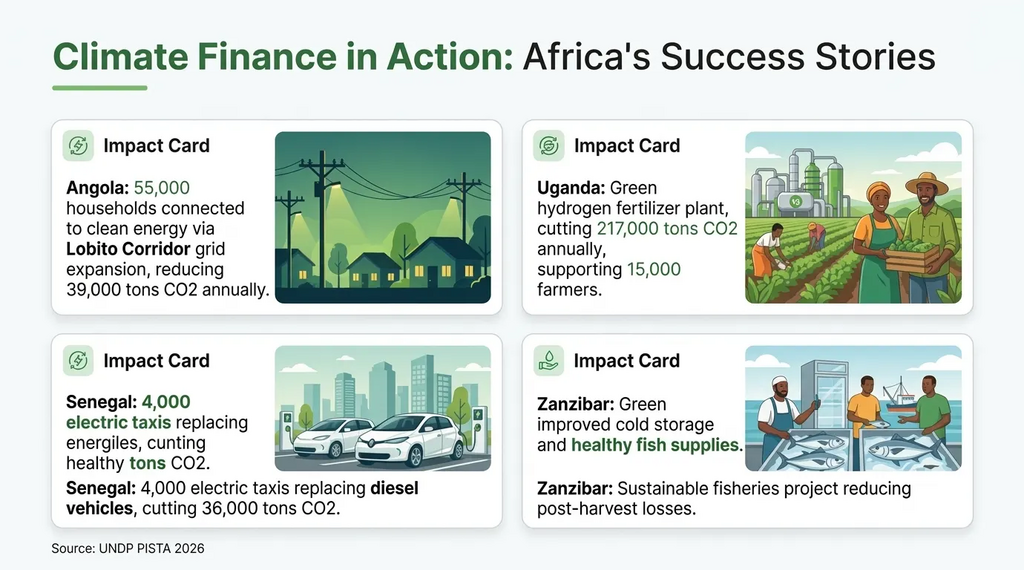
Dashboard showcasing UNDP PISTA climate finance projects in Africa.
The UNDP's PISTA initiative, which supports selected SMEs across Ghana, Kenya, Malawi, Mauritania, Republic of Congo, and Senegal, demonstrates how technical assistance can help bridge the investment readiness gap.
Sanjay Rughani, chief executive of Standard Chartered Bank in Uganda, calls the target of raising $50 billion annually through the Africa Climate Innovation Compact an achievable goal. He states, "It will require a lot of thinking around smart solutions, combining public, private and philanthropic capital, and structured solutions such as those from international institutions".
Policy Recommendations to Stakeholders
Africa’s climate finance gap is a systemic failure that demands coordinated action from multiple stakeholders. The following recommendations draw on findings from the African Union, the UN Economic Commission for Africa, and the outcomes of the Second Africa Climate Summit.
1. Global North to Deliver Climate Finance Commitments Action:
Fulfill climate finance pledges with transparency and accountability, ensuring funds reach frontline communities rather than being lost in bureaucratic channels.
Prioritize grant‑based financing over loans for African climate adaptation, recognizing that borrowing to fix a problem Africa did not create is unjust and unsustainable.
Support debt‑for‑climate swaps and provide guarantees that lower borrowing costs, easing debt burdens while freeing resources for climate action.
2. Multilateral Development Banks and UN Agencies: Simplifying Access Action:
Streamline procedures and reduce the heavy paperwork required to access climate funds, as current systems are too slow and exclusionary.
Scale up co‑financing and blended finance approaches that combine public, private, and philanthropic capital to de‑risk high‑impact climate projects.
Invest in local technical capacity through initiatives like the African Climate Facility and PISTA, enabling African institutions to design and manage projects effectively.
3. African Governments and the African Union: Strengthening Governance Action:
Enhance inter‑ministerial coordination to avoid fragmentation and wasted resources. Fully operationalize the AU Climate Change and Resilient Development Strategy and Action Plan (2022-2032) and the Africa Action Plan on Carbon Markets.
Crack-down on corruption and illicit financial flows through transparent procurement, independent oversight, and robust monitoring to ensure funds reach intended beneficiaries.
Build a pipeline of bankable climate projects and strengthen investment readiness for SMEs, creating conditions for large‑scale private sector participation.
4. Private Sector and Investors: Seizing Green Opportunities Action:
Recognize the commercial opportunities in Africa’s green transition, from renewable energy to sustainable agriculture, and deploy capital at scale rather than waiting for risk elimination.
Adopt strict, verifiable certification standards to build investor trust and avoid greenwashing, partnering with local institutions to deliver community‑focused projects.
Actively support women entrepreneurs and gender‑focused initiatives, acknowledging that women‑led climate projects deliver stronger outcomes and broader community benefits.
Bottom Line: Turning Promises into Action
Africa’s climate finance gap is both a global injustice and a massive missed economic opportunity. The continent contributes least to climate change yet suffers its worst impacts, while the current financial architecture systematically underfunds resilience with unaffordable loans.
Closing this gap requires urgent, coordinated action from wealthy nations, international financial institutions, African governments, and the private sector. The solutions are clear: grant‑based finance, debt relief, local capacity building, and good governance. What is needed now is the political will to turn promises into action.
Key Takeaways
1. Green Bond Innovation: African green bonds are growing, with South Africa accounting for nearly 74% of cumulative issuance, followed by Nigeria, Kenya, and Morocco.
2.Massive Funding Gap: Africa requires $250-300 billion annually for climate resilience but currently receives only about $28 billion, meeting only a fraction of actual needs.
3. Greenwashing Threat: The Blue Carbon scandal and other cases highlight how carbon credit schemes can fail, with deals covering millions of hectares ultimately proving to be hollow promises.
4. Certification Matters: A 2024 study of 107 African ESG bonds found that certified ESG bonds offer real benefits, while non-certified bonds do not.
5. Structural Reform Needed: The global climate finance architecture must shift from debt-heavy to grant-based financing for Africa, as current systems exacerbate rather than alleviate debt burdens.
Frequently Asked Questions
1. Why is climate finance important for Africa?
Climate finance refers to money flowing from developed to developing countries to support climate change mitigation and adaptation. For Africa, it is crucial because the continent bears the heaviest climate impacts despite contributing minimally to emissions. Africa requires an estimated $250-300 billion annually for climate resilience but receives only about $28 billion, highlighting a critical justice and development gap.
2. How do green bonds work?
Green bonds are debt securities where the money raised is exclusively used for projects with environmental benefits, such as renewable energy, energy efficiency, or sustainable agriculture. They have grown from a niche product to a mainstream asset class since the World Bank issued the first green bond in 2008.
3.What is greenwashing and why is it a concern?
Greenwashing involves making misleading environmental claims to appear sustainable. It undermines climate finance integrity by allowing investors to claim environmental benefits without real impact. Research shows non-certified ESG bonds do not offer comparable benefits to certified ones, highlighting the importance of robust standards.
4. What is Africa's role in global climate finance?
Africa accounts for less than 2% of global energy transition investment and less than 3% of global climate finance, despite being home to 17% of the global population. The continent hosts 25% of global biodiversity but receives less than 3% of nature finance globally.
5. What initiatives are helping bridge Africa's climate finance gap?
Key initiatives include the UNDP's PISTA providing technical assistance for bankable projects, the African Union's Africa Action Plan on Carbon Markets, and innovative instruments like Ecobank's Nature Bond. The African Development Bank is also central to mobilizing climate finance across the continent.
6. What are debt-for-climate swaps and how do they help Africa?
Debt-for-climate swaps are arrangements where a portion of a country's external debt is cancelled in exchange for commitments to invest in climate action. Kenya and Gabon have pioneered such swaps, demonstrating how creative financial mechanisms can simultaneously address debt distress and climate vulnerability. These instruments allow countries to redirect resources from debt servicing to climate resilience, breaking the cycle where countries borrow to survive climate disasters they did not create.